HubSpot Acquires Warmly
Warmly adds GTM AI and HubSpot-integrated agents.

Yesterday, HubSpot announced it acquired Warmly, an AI GTM Platform. The two companies have been partners since 2023, when Warmly built its first integration (with HubSpot).
Why is GTM difficult?
“One of the hardest problems in GTM is the gap between building demand and actually winning deals. Finding buyers who are showing intent and engaging them before a rep steps in is something most AI still requires a human to initiate,” stated HubSpot Product VP Angela DeFranco.
“Warmly has been solving exactly this, natively with AI: identifying anonymous visitors, scoring intent, executing personalized outreach across channels,” continued DeFranco. “This fits directly with our vision for an Agentic Customer Platform where teams and agents work from the same customer context to deliver more relevant, timely experiences through every stage of the customer journey.”
How has Warmly grown?
Warmly was founded in 2019 and pivoted several times. For a while, it was a B2C company, but it has gained traction over the past three years, rapidly growing its ARR to over $7.6 million.
Warmly raised $17 million across a Series A (Oct 2023) and A+ (Feb 2025) with rounds led by RTP Global and Felicis.
“Today we’re past $12M in all-time sales, almost $8M in ARR, and Warmly has gone from an idea to one of the most recognized GTM tools in the market — used by mid-market teams and logos you’d know,” stated Warmly CRO Keegan Otter.
While Warmly’s agentic GTM platform has been enjoying success the past two years, the firm struggled for its first several year, with multiple pivots.
“Back then, I was giddy. Just a guy with an idea & a few cofounders hoping to change the world of GTM forever,” posted Warmly CEO Maximus Greenwald on LinkedIn. “And then reality struck - building a company was hard! Every day we learned a little more, failed a little less, and 6 pivots later, advances in LLMs finally unlocked the product we’d been trying to build.”
In 2023, the firm focused on AI GTM and agentic AI. The firm “put everything we had into building AI Agents that would modernize how marketing & sales teams worked together.”
When did Warmly begin partnering with HubSpot?
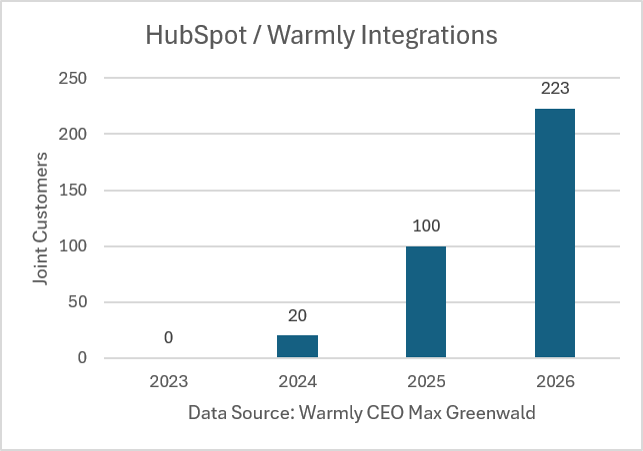
Warmly released its first connector (with HubSpot) in 2023, and by 2024 it had 20 joint customers.
However, it continued investing in the connector and by the time of acquisition, had grown its integrated customer count to 223.
How are Warmly and HubSpot integrated today?
As Warmly rolled out its AI Agents, it continued to share and request data with HubSpot:
AI Agents book customer meetings with HubSpot’s Data Hub as a “key source.”
Inbound Agent chats with website visitors. Warmly de-anonymizes the visitors and stores chat transcripts in HubSpot’s Smart CRM.
TAM Agent built “differentiated, fresh lead lists,” and GTM teams tracked pipeline via HubSpot’s dashboards.
How did Warmly build its data and agents to meet the four questions of GTM?
Warmly set out to answer four GTM questions:
Who is the buyer?
What do they care about?
When do they care?
How do we help?
Greenwald provided an overview of how it worked to resolve these questions and why its HubSpot partnership led to the acquisition:
Our first building block was intent. Warmly became best known for person-level website intent, helping companies identify more than half of the visitors who never filled out a form.
But insight without action has limited value. So we built Inbound Agent to turn intent into personalized conversations, meetings, and follow-up. Every interaction added context and learnings that improved the next inbound interaction.
Then TAM Agent took that loop beyond the website, helping teams engage ideal-fit buyers before they arrived. Inbound informed outbound. Outbound created new inbound. Every interaction made the next one more relevant.
The deeper we went into AI, the clearer it became: as execution gets easier to scale, judgment becomes more valuable. Marketing comes back to its most fundamental question: how do we actually help buyers and earn their attention?
HubSpot has spent more than twenty years building an integrated platform for the customer journey. Its hubs, data, workflows, and products were designed to work together rather than forcing customers to stitch together dozens of disconnected systems.
What stood out to us was not only the breadth of the platform, but the coherence underneath it…
HubSpot’s starting point has always been the customer, not the technology. We share a belief that the next generation of GTM will be built by people and agents working as one system. Agents carry context and learning from outcomes, and people bring judgment, taste, and empathy.
Warmly CEO Max Greenwald (June 30, 2026)
What’s next for Warmly?
In the near term, Warmly’s contracts, pricing, account team, product experience, and integrations will remain unchanged, and its agents “will continue running as they do.”
Warmly intends to integrate its context and agentic AI across HubSpot’s platform.
The deal was not announced on the HubSpot investor site, and no 8-K was filed, so it was probably deemed non-material. However, both companies confirmed the transaction. No financial information was released.
FAQ
What is Warmly’s context graph?
Warmly’s Context Graph is a unified timeline that captures four types of information for every account:
What happened to them • Website visits, intent signals, funding news, job changes, competitive research
What you did • Emails sent, ads served, calls made, sequences triggered
The notes around it • Rep observations, meeting summaries, deal context, why decisions were made
What resulted • Meetings booked, deals won, conversations had, outcomes tracked
Its context graph helps ground agentic decisions based on intent, engagement, business events/signals, conversations, and business results.
Warmly’s context data is sourced from website activity, CRMs (HubSpot/Salesforce), email engagement, sales engagement platforms (Outreach/Salesloft), LinkedIn ads, intent data (Bombora), social signals, call recordings (Gong/Fathom), and Slack discussions.
What Questions can a GTM Context Graph Answer?
The Context Graph helps agents answer questions such as
“Why did we reach out to this account?”
“Did our LinkedIn ads actually influence this deal?”
“What led to this meeting getting booked?”
“Should we re-engage this Closed Lost account?”
“What messaging resonated with this buyer?”
Prior to agentic AI, these questions required significant manual research, leading to many “gut” responses rather than fact-based ones. Agentic AI, however, requires business context to offer accurate account and deal answers and recommendations
What is a TAM Agent?
Instead of vibe coding a failed solution, Warmly offers a TAM Agent built on “actual infrastructure, so you don’t have to endure this pain,” explained Alan Zhao, Head of Marketing, Product Strategy, and AI, to GZ Consulting in March. “We spent 2 years building the infrastructure layer that scales all of that, and when layered into the rest of GTM, the results have been wild for us (4x ad CTR, 3-10% outbound conversion vs 0.1% before).”
Warmly’s TAM Agent is an AI-powered orchestration system that builds dynamic audiences, identifies buying committees, scores intent with transparent machine learning, and orchestrates multi-channel outbound. The TAM Agent doesn’t simply offer recommendations and leave sales reps to act on them; it acts automatically.
The TAM Agent performs context buffering, collecting signals from multiple sources before making decisions and avoiding noisy triggers from single events.
The TAM Agent contains dynamic subagents that support different capabilities (e.g., enrichment, scoring, routing) and act as specialized agents orchestrated by the TAM Agent. When processing a high-intent account, it simultaneously enriches contacts, updates audiences, and triggers sequences.
Feedback loops ensure that the TAM Agent continues to improve scoring and routing based on outcomes (e.g., meetings booked, deals closed).
Additional information is available in my March 2, 2026 Substack “Warmly TAM Agent”
What is an Inbound Agent?
Warmly released its Inbound Agent last fall to convert anonymous website visitor traffic into booked meetings. It performs person-level identification, chats with visitors, and books meetings. Leads are routed to sales reps by account, territory, or segment, with reps notified via Slack when high-value visitors are on the website.
Other features include dynamic website content personalized to the visitor and retargeting of prospects that failed to convert.
The chat is trained on each company’s product line and informed by previous conversations with the individual. It can handle objections, answer questions, and qualify interest around the clock.
Why do Warmly employees wear cowboy hats?
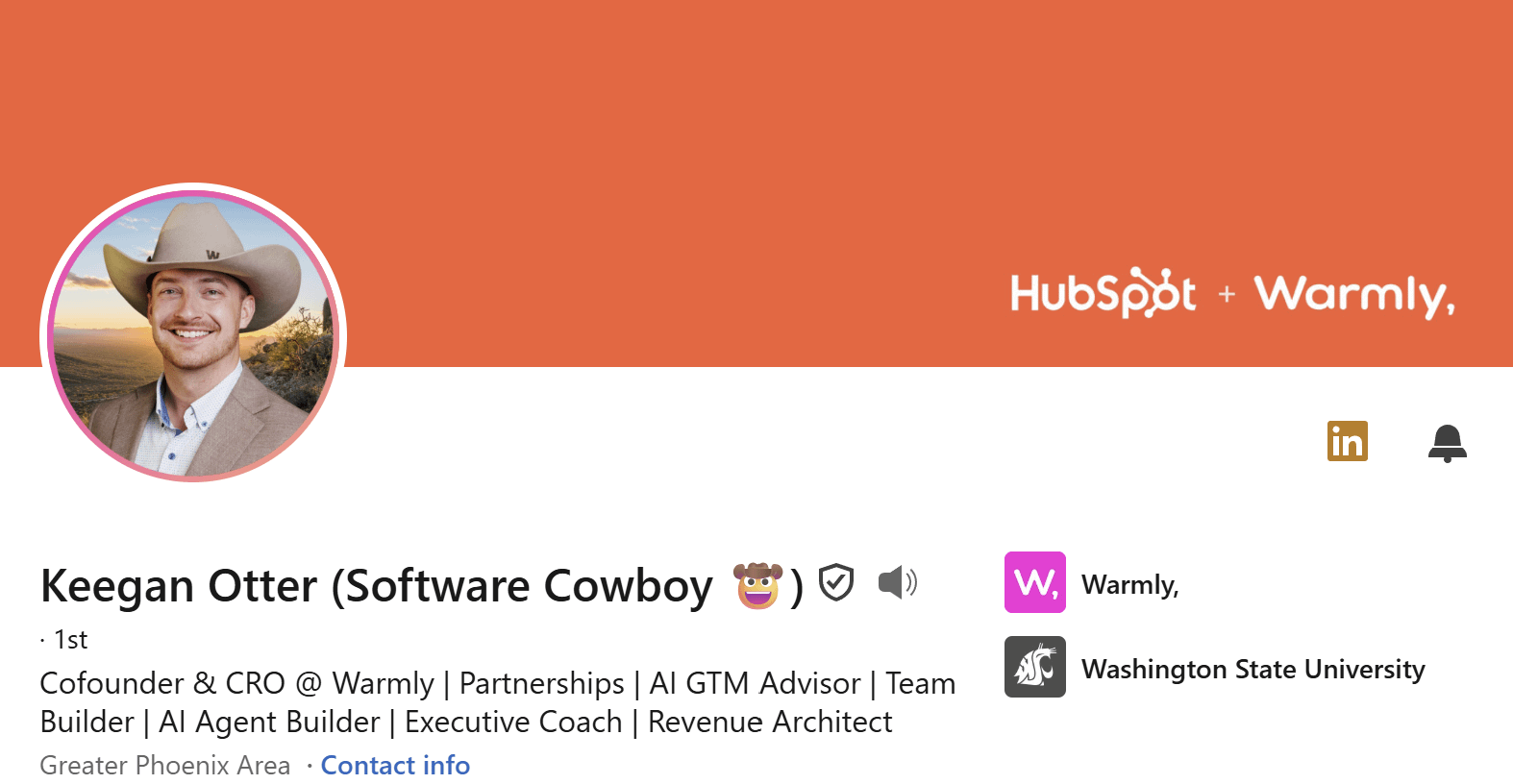
When Warmly attended its first conference three years ago (SaaStr), it was broke and had little ARR. CRO Keegan Otter, who calls himself a “Software Cowboy,” regularly wore cowboy hats and viewed it as part of his brand, so he went “full cowboy” and wore his custom hat and boots.
And the cowboy branding works. When I attended Outreach Unleash 2025 in Fort Lauderdale (not a cowboy town), the entire Warmly team wore cowboy hats on the tradeshow floor and at events. You knew they worked for Warmly, even if you hadn’t spoken to them.
Every new employee is issued a cowboy hat, including their SDRs based in Macedonia (not a cowboy country, but Alexander the Great was Macedonian, so they’ve used that heritage in their marketing as well).
“What started as a cool marketing idea is now a Warmly tradition where every new hire gets a custom cowboy hat, and now everywhere we go, people know it’s Warmly cause of the hats,” remarked Otter.
Additional Resources
Warmly: Website
GZ Consulting: “Warmly TAM Agent” | “Warmly A+ Round” | ABX Platforms | ICP | “Visitor Tracking” DaaS | Demand Generation
My Substack newsletter is a subset of my subscription industry newsletters. Substack content is generally embargoed at least a week before publication. You can contact me at Michael Levy for licensing details.
Published: July 1, 2026
Author: Michael R. Levy, GZ Consulting